| Latin Name |
Bassariscus sumichrasti |
| Conservation Status |
Least Concern |
| Location
| Central & South America |
| Colour |
Buff/Grey/Brown |
| Length |
38 - 47 cms (15 - 18.5 inches) |
| Tail |
39 - 53 cms (15.4 - 21 inches) |
| Weight |
0.8 - 1 Kgs (1.8 - 2.2 lbs) |
| Life Expectancy |
Up to 23 Yrs (in Captivity) |
Main Characteristics
Cacomistles have a body length between 38 and 47 cms (15 - 18.5 inches), a tail length between 39 and 53 cms (15.4 - 21 inches) and they weigh between 0.8 and 1 kgs (1.8 - 2.2 lbs).
They are buff/grey to brown in colour with a distinctive tail that is ringed in black and buff bands.
Habitat
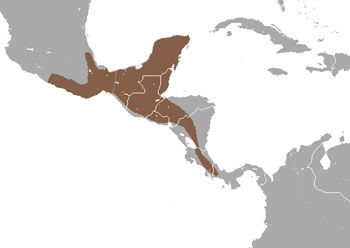
Cacomistles can be found in the mountain forests and wet tropical woodlands of central and southern America from southern Mexico to western Panama.
Diet
Cacomistles are omnivores and they feed upon small rodents, birds, lizards, frogs, insects, eggs and fruits.
Breeding
After a gestation period of 63 - 66 days, Cacomistles give birth to a single youngster.
Predators
Predators of Cacomistles include birds of prey, ocelots, tayras, large snakes and humans.
Subspecies
Subspecies of the Cacomistle are:
Bassariscus sumichrasti latrans
Bassariscus sumichrasti notinus
Bassariscus sumichrasti oaxacensis
Bassariscus sumichrasti sumichrasti
Bassariscus sumichrasti variabilis
Interesting Facts
Cacomistles are also sometimes known as a Ringtail Cat, but they shouldn't be confused with the species bassariscus astutus.
Similar Animals
Ringtail
Red Panda
Common Raccoon
Crab-Eating Raccoon
Mountain Coati
White-Nosed Coati
South American Coati
|